


Unexploded ordnance survey
Before any construction project on ground that may contain unexploded ordnance, the subsoil has to be examined. This is done with probe drillings in a fixed grid.

Where drilling takes place
Probe drilling in a grid
Probe drillings are distributed in a grid across the area to be examined. Each borehole takes a measuring probe that checks the soil for magnetic anomalies. Small diameters, moderate depths and a very large number of drilling points in a row are typical.
Two requirements shape the method
Low vibration: the holes are drilled, not driven. Whatever may be lying in the ground must not be put under mechanical stress. And positional accuracy: a survey is only as good as its grid. If a borehole deviates, a gap appears in the survey picture.
Why it is demanding
- No hammering allowed. Driving creates vibrations, which is why the holes are drilled.
- The grid has to be right. Every deviating borehole is a gap in the survey picture.
- There are a great many points. Dozens to hundreds of almost identical boreholes per site.
How and why an MGF drill motor is used here
Small and light
The BG 260 weighs 40 kilograms and delivers 2,560 Nm; the BG 800 weighs 120 kilograms at 8,000 Nm. Both can be mounted on comparatively small carrier machines – important on sites that have not yet been cleared.
Smooth, steady running
The hydraulic drive turns without gear steps and without impact. For probe drilling, that is not a comfort feature but a requirement of the method.
Made for many identical boreholes
A survey consists of dozens to hundreds of almost identical boreholes. This continuous load is exactly why a drive without a gearbox lasts longer here.
MGF says so itself
In the product overview, the BG 260 is described as a compact earth drill for unexploded ordnance surveys and the BG 800 as a popular earth drill for this work. It is the application these models were built for.
Which model for which survey
| Task | Torque · Weight | MGF models |
|---|---|---|
| Compact probe drilling, smallest carrier machines | 2,560 Nm · 40 kg | BG 260 |
| Precise probe drilling | 4,800 Nm · 80 kg | BG 480 |
| Standard for unexploded ordnance surveys | 8,000 Nm · 120 kg | BG 800 |
| Probes with larger diameters | 10,800 Nm · 170 kg | BG 1080 |
Drive and tools from one source
Besides the drive, a probe borehole needs the right rods and drill bit. For a method made up of hundreds of similar boreholes, one supplier instead of two is a real advantage, especially when restocking wear parts.

Frequently asked questions
Because driving creates vibrations. Drilling puts as little mechanical stress on the ground as possible.
A carrier machine with a hydraulic drill motor. For the usual probe diameters, compact drives from 2,560 to 10,800 Nm are enough.
That depends on the grid and the area. In practice, it is dozens to hundreds of boreholes per site.


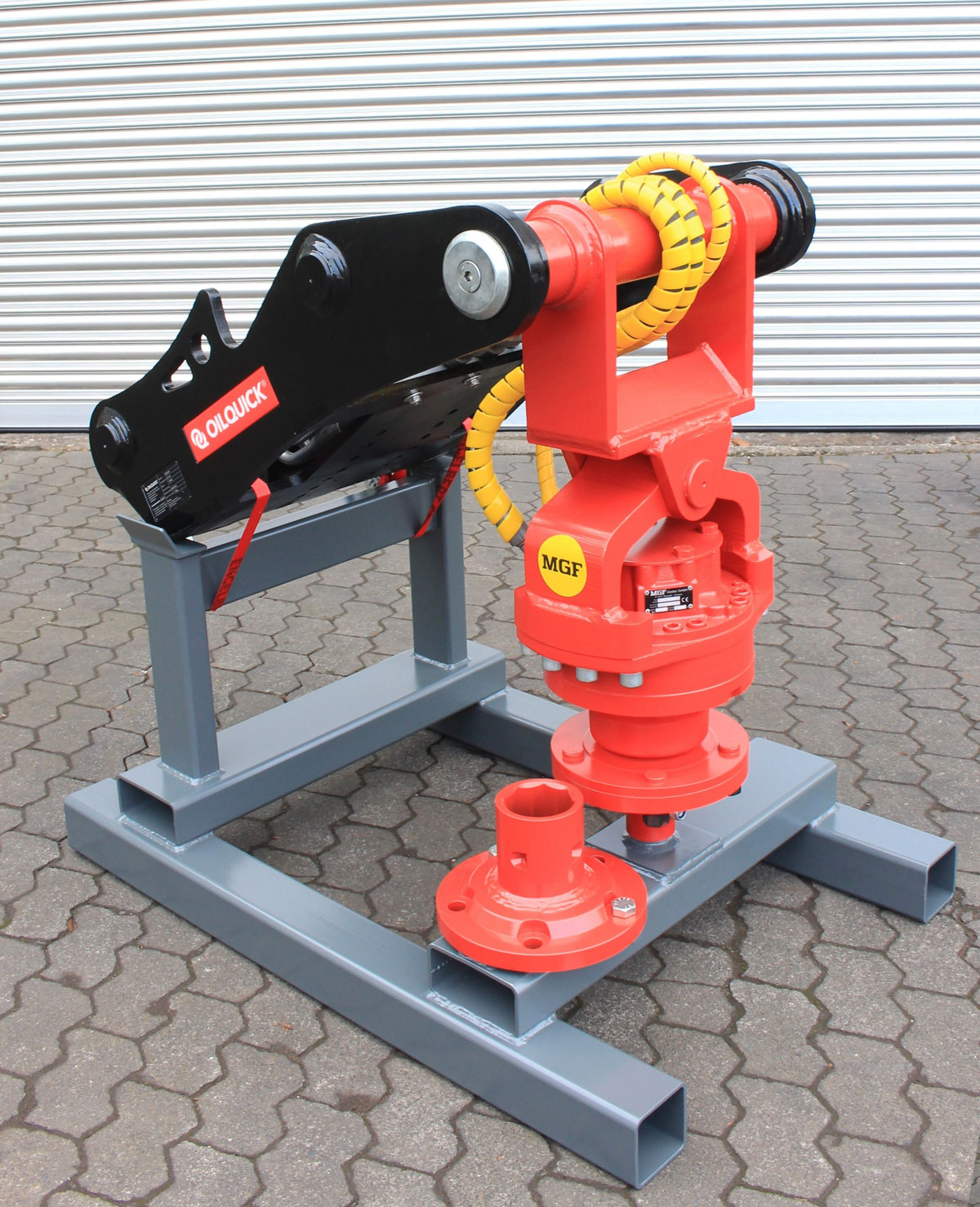
Which drive suits your excavator?
Tell us your machine, oil pressure and oil flow. We will size the drive.



Get advice now — and find the right model
Discover the benefits of our low-maintenance, hydraulic earth drilling rigs. Let our experts advise you on this.


Site created by famesites