


Railway construction
Along every railway line there are foundations: for overhead line masts, for noise barriers, for signals. Many of them start with a borehole right next to the track.

Where drilling takes place
Foundations for overhead line masts
Every overhead line mast needs a foundation. Drilling takes place along the line, mast by mast, often over many kilometres.
Foundations for noise barriers
The posts of a noise barrier stand in boreholes set in close succession parallel to the track.
Foundations for signals and trackside equipment
Signals, control cabinets and other equipment along the track need smaller but equally accurate foundations.
Why it is demanding
- The time window is tight. Work takes place during track possessions, often at night. Whatever isn't finished in one possession has to wait for the next.
- The drilling point is on the track, not on the road. Many sections are hard to reach with truck-mounted drilling rigs. The way to the drilling point is via the rails.
- Working height is limited. Under an existing overhead line, any machine with a tall mast is ruled out.
- There are many identical boreholes. Mast after mast, post after post: continuous load along the whole line.
How and why an MGF drill motor is used here
On the road-rail excavator
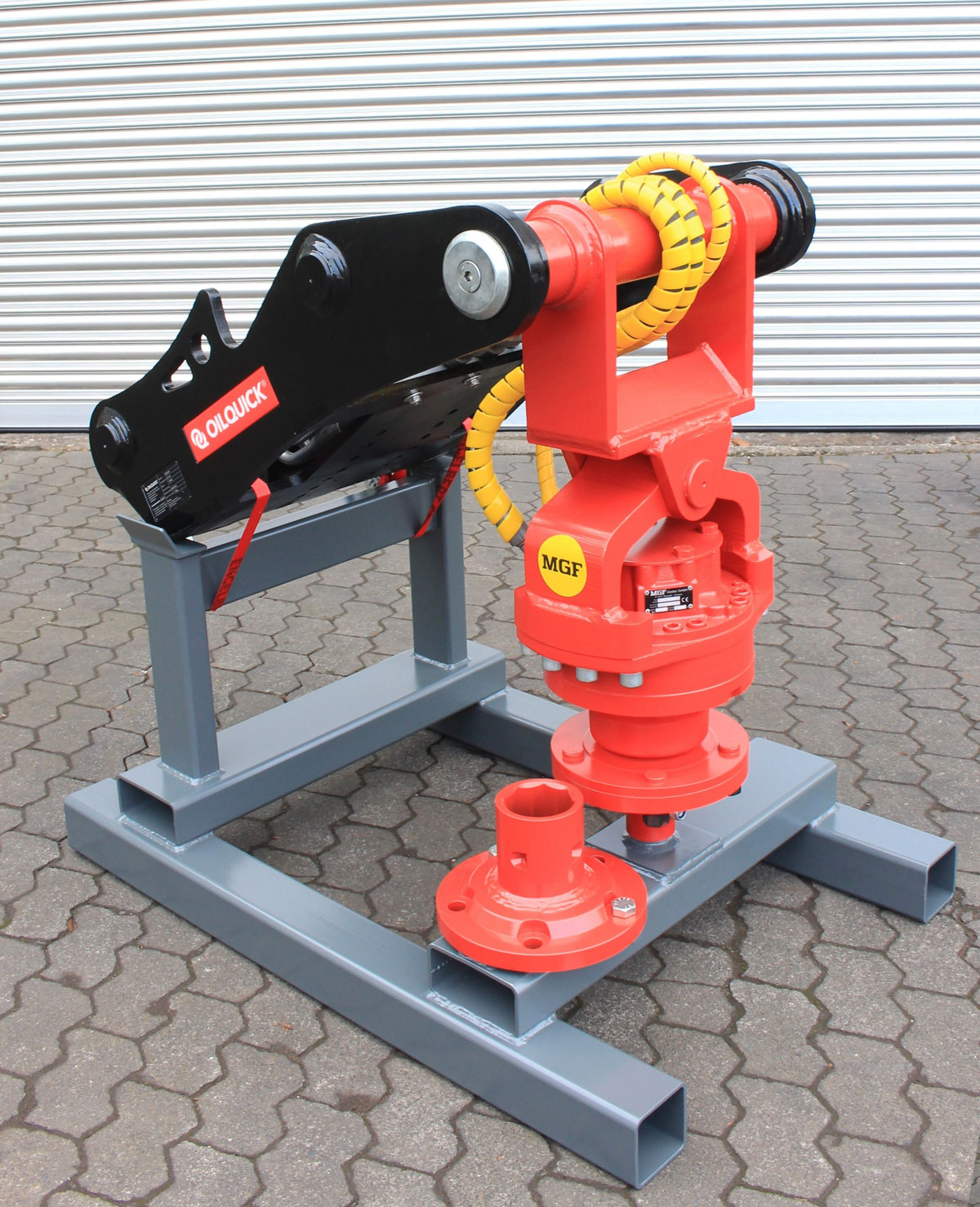
The drive sits on the boom of the road-rail excavator, which travels along the rails to the drilling point. No additional drilling rig, no relocating via the road.
No mast
The overall height is determined by the drive and the tool, not by a drilling mast. Under an existing overhead line, that is the decisive difference.
Continuous load without a gearbox
A line consists of dozens to hundreds of similar boreholes. This is exactly the kind of load under which a gearbox wears, and the hydraulic drive doesn't have one.
Power at low speed
Railway embankments often consist of compacted ballast and mixed material. The hydraulic drive stays powerful even when the tool slows down in firm material.
Which model for which task on the track
| Task | Torque | MGF models |
|---|---|---|
| Signal and cable foundations, small diameters | 4,800 – 10,800 Nm | BG 480 · BG 800 · BG 1080 |
| Posts for noise barriers | 10,800 – 19,200 Nm | BG 1080 · BG 1780 · BG 1920 |
| Foundations for overhead line masts | 17,800 – 32,000 Nm | BG 1780 · BG 2680 · BG 3200 |
Drive and tools from one source
The drive comes with an auger, a drill bit and, for cased foundations, the casing pipes.

Frequently asked questions
Yes. As on any excavator, the drive is mounted on the boom and matched to the machine's oil pressure and oil flow.
Often with bored foundations: a hole is drilled, the mast base or an anchor cage is inserted, and concrete is poured.
Yes, with a method that doesn't need a drilling mast. An excavator-mounted drill motor only needs the height of the drive and the tool.


Which drive suits your excavator?
Tell us your machine, oil pressure and oil flow. We will size the drive.



Get advice now — and find the right model
Discover the benefits of our low-maintenance, hydraulic earth drilling rigs. Let our experts advise you on this.


Site created by famesites